

Anyone who has lived through an August late-afternoon thunderstorm in Central Alabama knows just how fast the sky can open up. One minute you’re sitting on the porch enjoying a quiet summer day, and the next, a wall of water is slamming down on your roof. These torrential downpours drop massive amounts of water in a matter of minutes. When that happens, your home relies entirely on one critical defense system to keep that deluge away from your foundation: your gutters.
If you step outside during a heavy storm and see water cascading over the sides of your roof like a waterfall, you’re not alone. Homeowners from Montgomery up to Birmingham frequently ask us how to stop gutters from overflowing in heavy rain. The truth is that standard residential gutters installed decades ago were simply not designed to handle the sheer intensity of Southern storm cells. Upgrading your water management system is one of the smartest ways to protect your property, but choosing between standard and oversized channels requires understanding how the math actually works.
At IRoof, we believe in giving our neighbors straight answers based on over 25 years of local experience. We are your neighbor with a roofing license, and we’re here to help you protect what matters most. Let’s look at the differences between standard 5-inch and oversized 6-inch systems, how our severe weather changes the equation, and why a properly sized water management system saves you thousands in hidden repairs.
Key Takeaways
- Massive Capacity Increase: Upgrading to 6-inch gutters gives you roughly 44% more drainage area and holds 67% more water per foot than standard 5-inch channels.
- Eliminates Downspout Bottlenecks: Pairing oversized channels with 3×4-inch downspouts doubles the exit capacity and prevents clogging from storm debris.
- Protects Fascia and Foundations: Proper sizing prevents water from cascading over the trough, stopping fascia board rot, soffit damage, and soil erosion.
If your water management system is struggling to keep up with summer storms, IRoof is here to help. Schedule your free inspection and let us protect your home, together.
Why Central Alabama Summer Downpours Test Your Gutters
When contractors calculate drainage needs in other parts of the country, they often look at average annual precipitation. But here in Central Alabama, annual averages don’t tell the whole story. What really tests a home’s water defense is peak rainfall intensity.
During our peak storm season, isolated thunderstorm cells can easily dump water at a rate equivalent to 7 to 11 inches per hour during a brief five-minute burst.
When that sudden volume of water hits a steep roof, it accelerates quickly toward the edges. If your trough capacity cannot hold that initial surge, the water immediately backs up and spills over the front and back lips.
What’s The Role of Roof Pitch in Water Velocity?
The shape and angle of your roof play a massive role in how fast water hits your drainage system.
Steeper roof pitches send water roaring down toward the eaves at high velocity. As that fast-moving stream reaches the edge, it creates a phenomenon known as splashback. If the trough is too narrow, the water simply bounces right over the front edge, completely bypassing the channel.
What’s The Problem with Short-Burst Storms?
Unlike long, gentle rains, August storms drop their entire volume in sudden, heavy cloudbursts. This puts immense, immediate weight on your hangers and tests every single connection point along your roofline.
What Are The Important Factors to Consider Before Upgrading Your Gutters?
Before deciding on a gutter replacement in Montgomery, AL, or the surrounding areas, take a moment to evaluate a few key factors around your property.
The Size and Layout of Your Roof
Larger roof planes collect massive amounts of water. If your home has wide, sweeping roof slopes without many breaks or dormers, all that rainwater funnels into a single long run.
Tree Coverage and Debris
If your home is surrounded by mature oaks, pines, or sweetgum trees, pine needles and leaves constantly settle on your roof. Smaller channels choke on debris quickly, whereas wider channels allow water to flow around minor obstructions.
Existing Foundation and Landscaping Damage
Take a walk around your home after a heavy rain. If you notice deep trenches carved into your flowerbeds, cracked walkways, or pooling water against your foundation, your current system is failing to control the flow.
Fascia Board Condition
When water constantly overflows the back of an undersized trough, it trickles down the wood behind it. Over time, this rots the fascia board and loosens the mounting brackets holding the entire system up.
If you’re seeing any of these warning signs around your property today, we can walk you through every step of evaluating your home, no pressure, no guesswork.
6 Inch Gutters vs 5 Inch Gutters: Breaking Down the Capacity
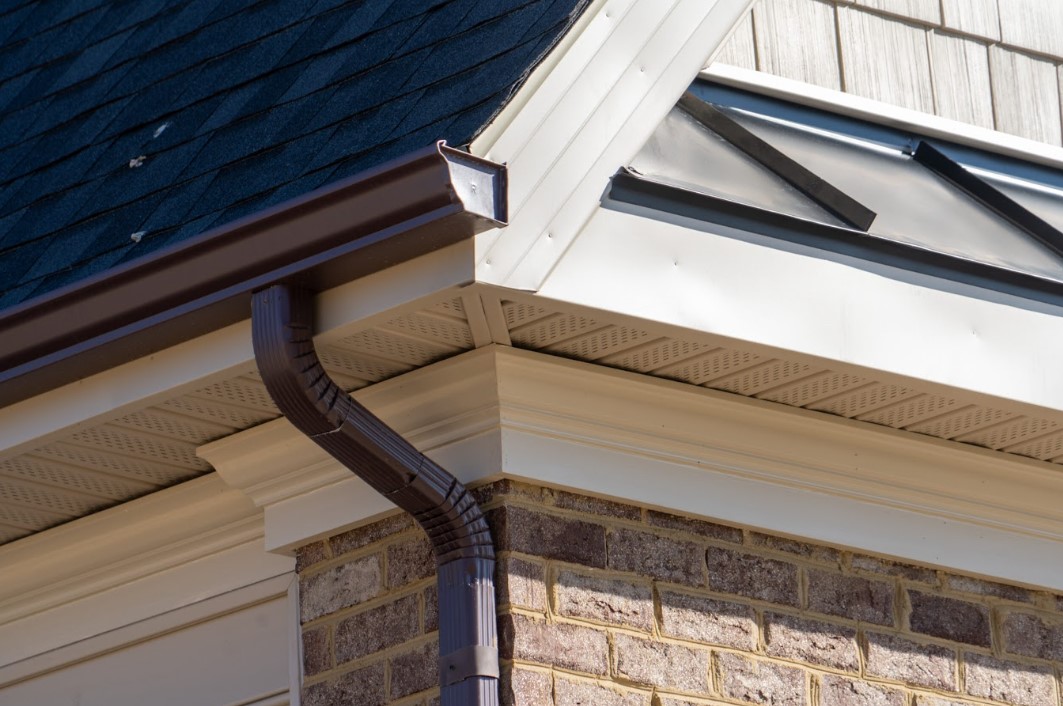
When homeowners compare 6-inch gutters vs 5-inch gutters, it can be tough to visualize the real difference from the ground. After all, one extra inch across the top opening does not sound like a huge change. However, in terms of volume and fluid dynamics, that single inch transforms the entire performance of the system.
Here is how the numbers break down according to industry standards:
- Standard 5-inch K-style gutters: Hold approximately 1.2 gallons of water per linear foot and are rated for smaller roof planes under baseline conditions.
- Oversized 6-inch K-style gutters: Hold roughly 2.0 gallons of water per linear foot and handle significant runoff from large, steep roofs.
- That single extra inch yields roughly 44% more overall drainage capacity and allows the channel to hold 67% more water volume per foot of length.
When a sudden cloudburst hits your Alabama home in August, that extra capacity acts as a vital safety buffer. It gives the water enough space to pool briefly without sloshing over the edges while it waits to drain through the outlets.
The Downspout Factor: Eliminating the Exit Bottleneck
A gutter channel is only as good as its outlets. Installing a wider trough while leaving small, undersized downspouts in place is like trying to empty a swimming pool through a garden hose. The water will simply fill up the channel and spill over the sides anyway.
To truly understand how to stop gutters from overflowing in heavy rain, you have to look at the complete water exit pathway.
Standard 2×3-inch Downspouts
Standard 5-inch systems are typically installed with 2×3-inch rectangular downspouts. These outlets have a drainage capacity of roughly 600 square feet of roof area. Because they’re relatively narrow, twig debris, leaves, and pine straw can easily bridge across the opening and create a total blockage.
Oversized 3×4-inch Downspouts
When we perform an oversized seamless gutter installation in Birmingham, AL, we pair 6-inch channels with heavy-duty 3×4-inch downspouts. These larger pipes handle approximately 1,200 square feet of drainage capacity each, effectively doubling the speed at which water leaves your roofline.
The wider opening allows small leaves, twigs, and roof granules to pass right through without catching, keeping your system free-flowing even during peak storm conditions.
Why Seamless Aluminum Construction Matters
In addition to size, how your gutters are built makes a massive difference in how long they last. Older traditional systems were put together using 10-foot sectional pieces snapped or caulked together.
Over time, temperature shifts cause those individual seams to expand, contract, and pull apart. Once a seam breaks, water constantly drips through, rotting your wood trim and staining your siding.
At IRoof, we custom-fabricate seamless aluminum gutters directly on-site at your home.
Here’s why seamless construction gives you superior protection:
- Zero Mid-Run Seams: The continuous channel is custom-cut to the exact length of your home’s roofline, completely removing weak leak points.
- Smoother Water Flow: Without internal joint ridges catching debris, water and leaves slide directly toward the downspouts.
- Heavy-Gauge Aluminum: We use thick .032-gauge aluminum that will not sag, warp, or rust under the immense weight of heavy water flow.
- Custom Color Matching: Seamless aluminum comes in a wide variety of durable factory finishes designed to match your home’s trim and boost curb appeal.
Services We Offer Beyond Gutters
While managing rain runoff is vital, your gutters are just one part of your home’s complete exterior defense system. At IRoof, we offer a full suite of services to ensure your entire property stays protected from Central Alabama weather:
- Residential Roofing: High-quality asphalt shingle and standing seam metal roofing options installed by experienced local professionals.
- Commercial Roofing: Complete roof management, repair, and replacement solutions for local business owners.
- Storm Damage Repair: Rapid response and honest inspections following high winds, hail, or severe weather events.
- Gutters: Custom seamless gutter design, fabrication, oversized upgrades, and downspout installation.
- Insulation: Professional attic insulation upgrades to stabilize indoor temperatures and reduce summer cooling costs.